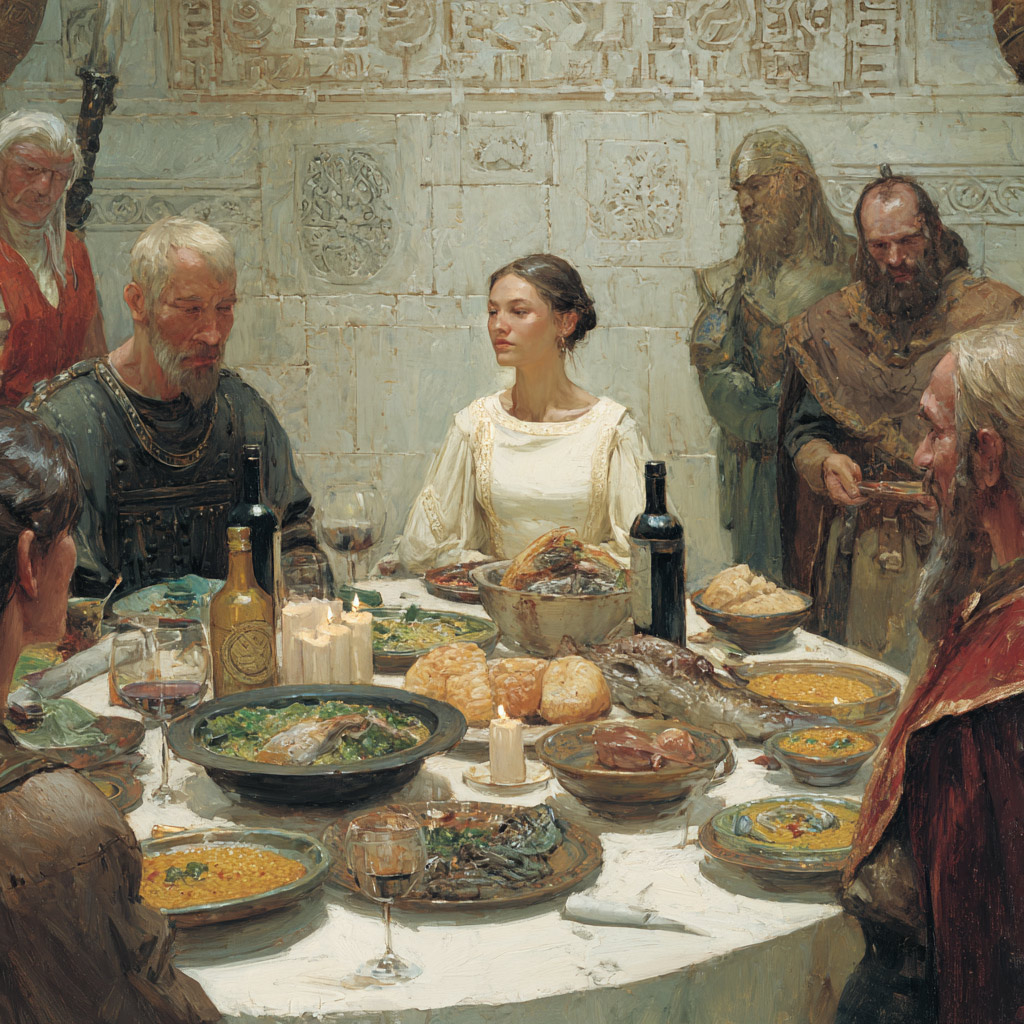
 Mother’s Plate occupies a peculiar and very Aranthaen space between restaurant, devotional exercise and social performance. Its menu is drawn from dishes described in the Holy Book of Bune, prepared as faithfully as possible from surviving recipes, temple traditions and scholarly interpretation.
The result is food presented as pious simplicity, though little about the experience is actually simple. Lentils arrive perfectly seasoned, breads are made from carefully sourced heritage grains, river fish are served with herbs grown in temple gardens, and humble stews emerge from the kitchens after hours of meticulous preparation. The ingredients may be traditional; their quality most certainly is not.
The dining rooms reflect the same contradiction. Pale stone, carved devotional panels and bowls of floating candles give Mother’s Plate the restrained atmosphere of a wealthy private chapel, while attentive servers pour wines costing 50 gp a bottle beneath quotations concerning humility, charity and gratitude.
For prosperous City Tier families, the restaurant offers the comforting sensation of participating in something ancient and virtuous without enduring any corresponding hardship. Meals are popular after important temple observances, during religious festivals and whenever fashionable society develops a sudden interest in spiritual reflection.
The clergy have never entirely agreed what to make of it. Some regard Mother’s Plate as a sincere celebration of Bune’s teachings and welcome the renewed interest in old culinary traditions. Others have observed, rather pointedly, that the Holy Mother probably did not intend a bowl of bean stew to require a reservation three weeks in advance.
Either way, the tables remain full.
Encounters
Mother’s Plate attracts the devout, the fashionable, senior clergy, wealthy families and City Tier diners who enjoy combining excellent food with a reassuring sense of virtue. Most encounters here are social, religious or quietly political, though conversations over lentils and fifty-gold wine can carry surprising weight. Roll d10 for possible encounters…
- A wealthy couple are earnestly debating which charitable kitchen should receive their donation while simultaneously sending back a dish because the bread is not warm enough. The server’s expression remains admirably neutral.
- A young cleric visiting from a poorer temple is visibly uncomfortable with the prices and grandeur of the restaurant. An older diner overhears them mutter that the Widow’s Pot costs more here than their temple spends feeding twenty people, and an awkward theological discussion begins.
- A City Tier family has ordered the Meal of Reconciliation following a bitter inheritance dispute. The bread has been broken, the shared wine poured, and nobody has yet said a single conciliatory word.
- A culinary scholar is arguing with one of the restaurant’s cooks over the correct interpretation of a passage in the Holy Book of Bune. The disagreement concerns whether a particular herb should be crushed or torn and has somehow become deeply personal.
- A diner quietly purchases twenty Charitable Plates after finishing an extravagant meal, then insists that nobody be told who paid for them. Unfortunately, another guest has already recognised them.
- A visiting noble has ordered the Pilgrim’s Supper to demonstrate humility to their companions, then spends the entire meal complaining that the portions are too small and asking whether there is any butter.
- A senior priest is approached by an anxious young woman carrying a folded letter. Whatever is written inside causes the priest to abandon dessert immediately and leave through the kitchens rather than the front entrance.
- A group of fashionable diners has begun discussing which dishes are the most spiritually authentic with the confidence of people who have never cooked any of them. At the neighbouring table sits an elderly woman from the Wynds who has eaten versions of several since childhood and is becoming increasingly amused.
- The restaurant receives an unexpected delivery of bread, vegetables and preserved food from one of the Church’s charitable kitchens. A clerical error has sent several days of supplies to Mother’s Plate instead, and the staff now face the mortifying prospect of explaining why food intended for the poor is sitting beside the wine cellar.
- At a large but deliberately plain table sit Ermile Valenor, Mother Overseer and second only to the Holy Mother in the Church’s daily hierarchy, together with the three Mothers Superior: Vyvaen Weller, Warden of the Sanctum; Thaelema Arkannis, Steward of the Basket; and Orlonas Dasir, Prefect of Doctrine. Four of the most powerful women in the Church sharing a meal naturally attracts attention, though anyone staring too openly may discover that Orlonas has been watching them for considerably longer.